


We have never had this much information at our fingertips. The problem is that having more information does not necessarily mean being better informed.
A headline becomes a Facebook post. A statement gets reduced to a quote card. Allegations become accepted as facts after being repeated often enough. And when politics enters the discussion, separating what has actually been established from what has merely been alleged becomes even harder.
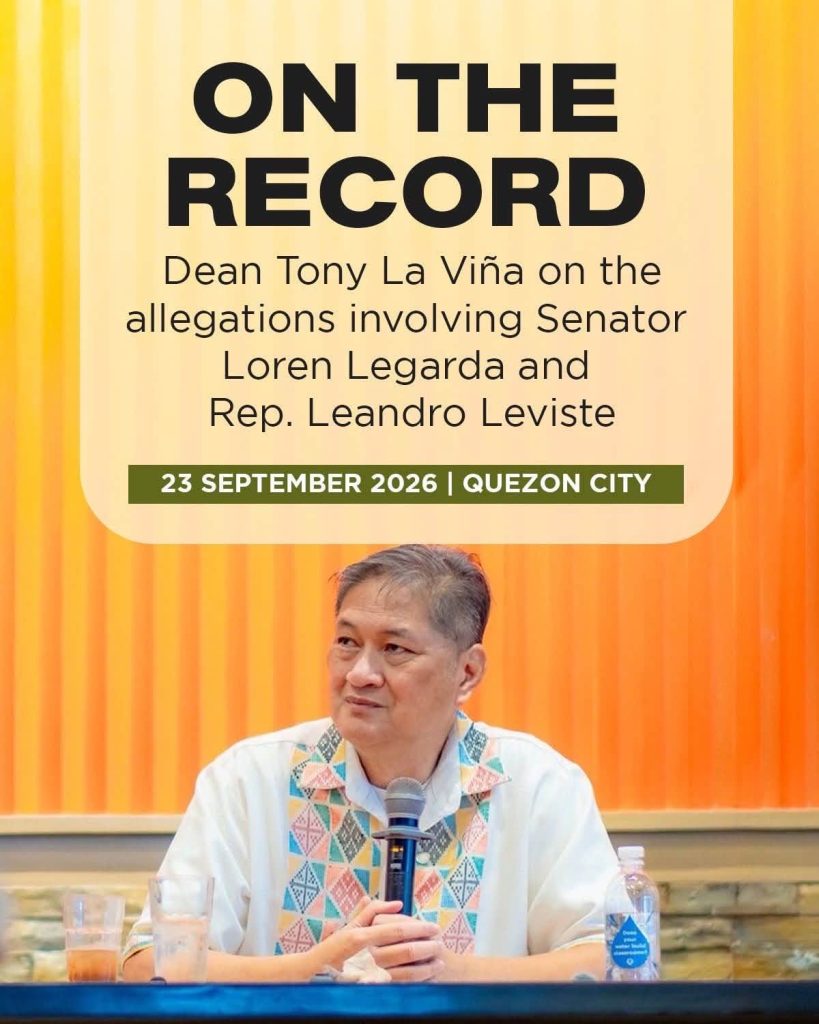
That is why, when we had lunch with Dean Antonio Gabriel “Tony” La Viña on September 23, the objective was simple: understand his side of the controversy involving Senator Loren Legarda, her son Batangas Rep. Leandro Leviste, and Leviste’s renewable-energy businesses.
La Viña is Legarda’s spokesperson and a member of her legal team, so what follows should be understood in that context. These are the explanations and arguments he presented in response to the allegations against Legarda and Leviste—not findings by a court or an independent determination of their innocence or liability.
La Viña is a lawyer and educator who formerly served as dean of the Ateneo School of Government. He currently heads the Klima Center of the Manila Observatory and is managing partner of La Viña Zarate and Associates. He has also worked as a human-rights lawyer for 36 years.
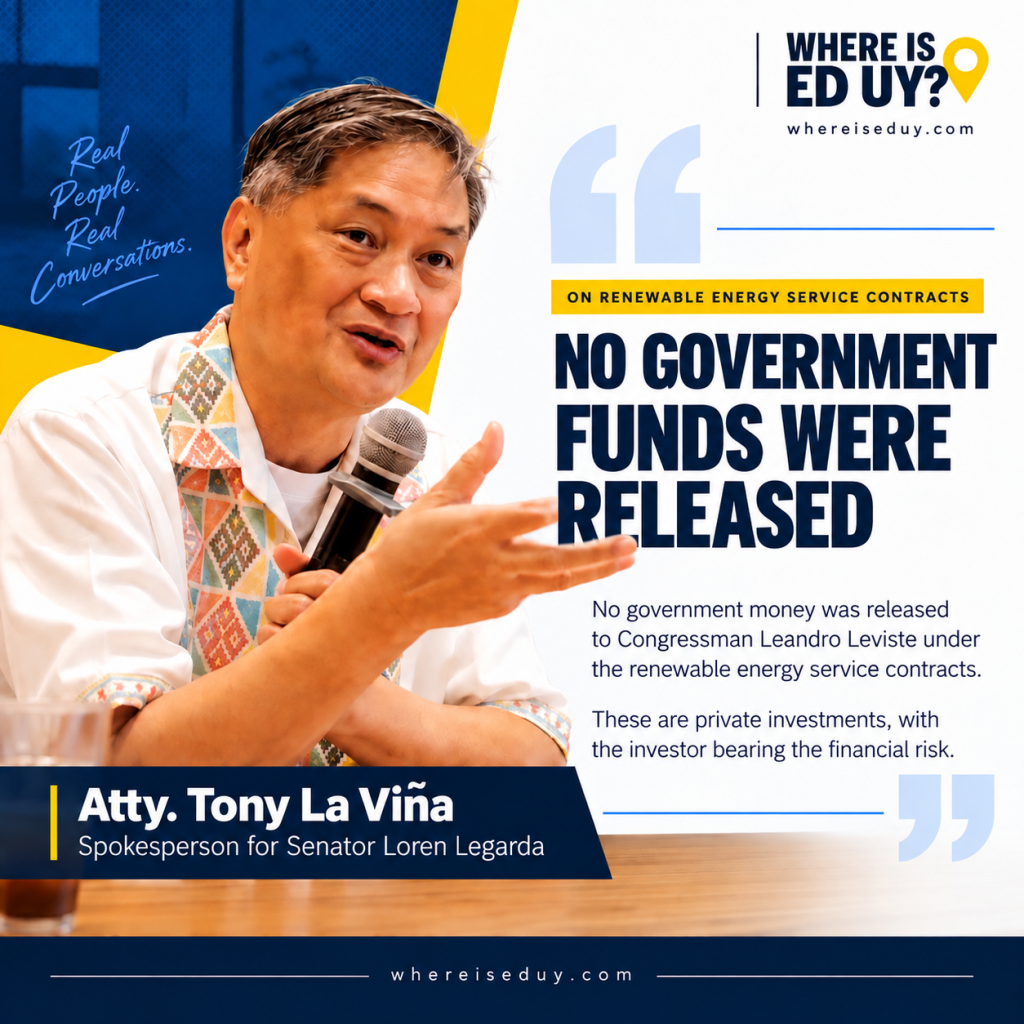
The controversy has become complicated because several different issues—the Solar Para sa Bayan franchise, renewable-energy service contracts, unfinished projects, financial obligations and Legarda’s alleged involvement—are frequently discussed as though they were the same thing.
La Viña argues that they are not.
What is a renewable-energy service contract?
One of the biggest misconceptions La Viña sought to address involved the nature of the renewable-energy service contracts themselves.
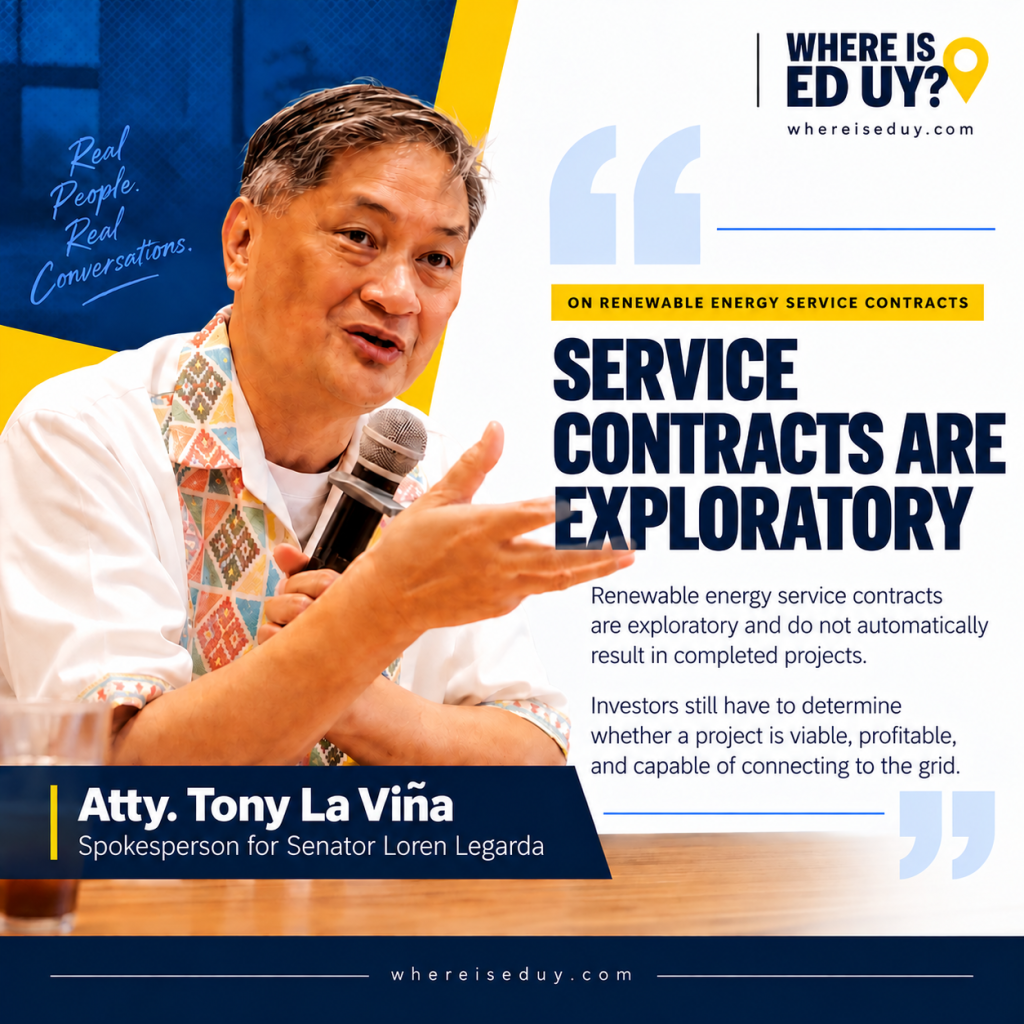
According to him, these were not government-funded projects in which billions of pesos were handed to Leviste to construct solar facilities.
“Risk yun, all the risk is with the investor,” La Viña said.
He explained that renewable-energy service contracts involve exploration and development, with private investors putting up their own capital and determining whether projects are technically and commercially viable.
That distinction is important to his defense because a project receiving a service contract does not necessarily mean a completed solar facility will eventually result from it.
Some projects move forward. Others do not.
La Viña therefore rejects the idea that every project that fails to reach commercial development can automatically be characterized as corruption or plunder.
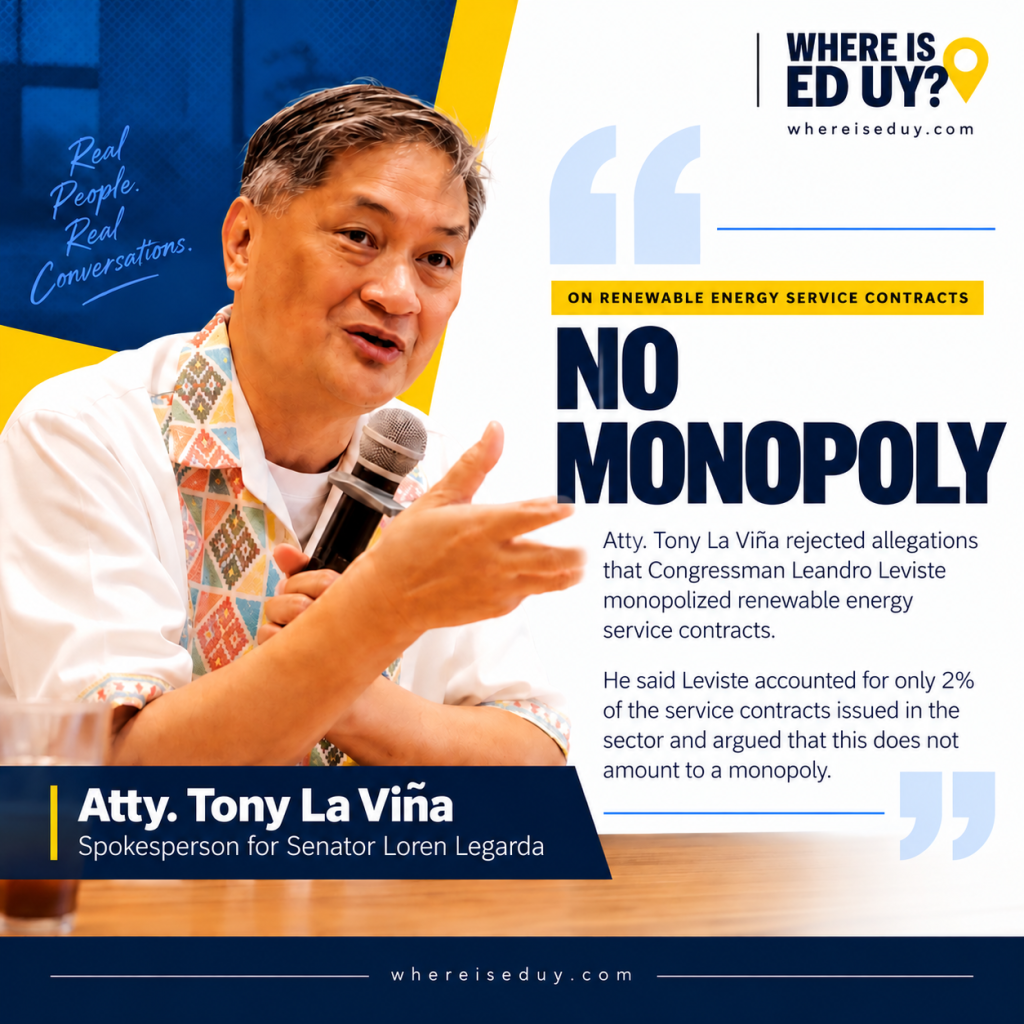
“Kung sasabihin mo na plunder every time an investor is not able to go to the next stage, wala nang mag-i-invest sa Pilipinas. Why would you?”
His position is not that unsuccessful projects carry no consequences.
La Viña acknowledged that projects that do not proceed can result in financial obligations.
“Merong ibang hindi nag-succeed. Kung hindi ka mag-succeed, meron kang financial obligations na kailangan i-fulfill,” he said.
In Leviste’s case, La Viña said those obligations amounted to approximately P92 million and had been paid.
“May resibo kami diyan.”
No government money?
This leads to another distinction La Viña repeatedly emphasized.
“No government funds were used,” was his categorical position.
According to La Viña, the renewable-energy projects involved private investment rather than the release of government money to Leviste.
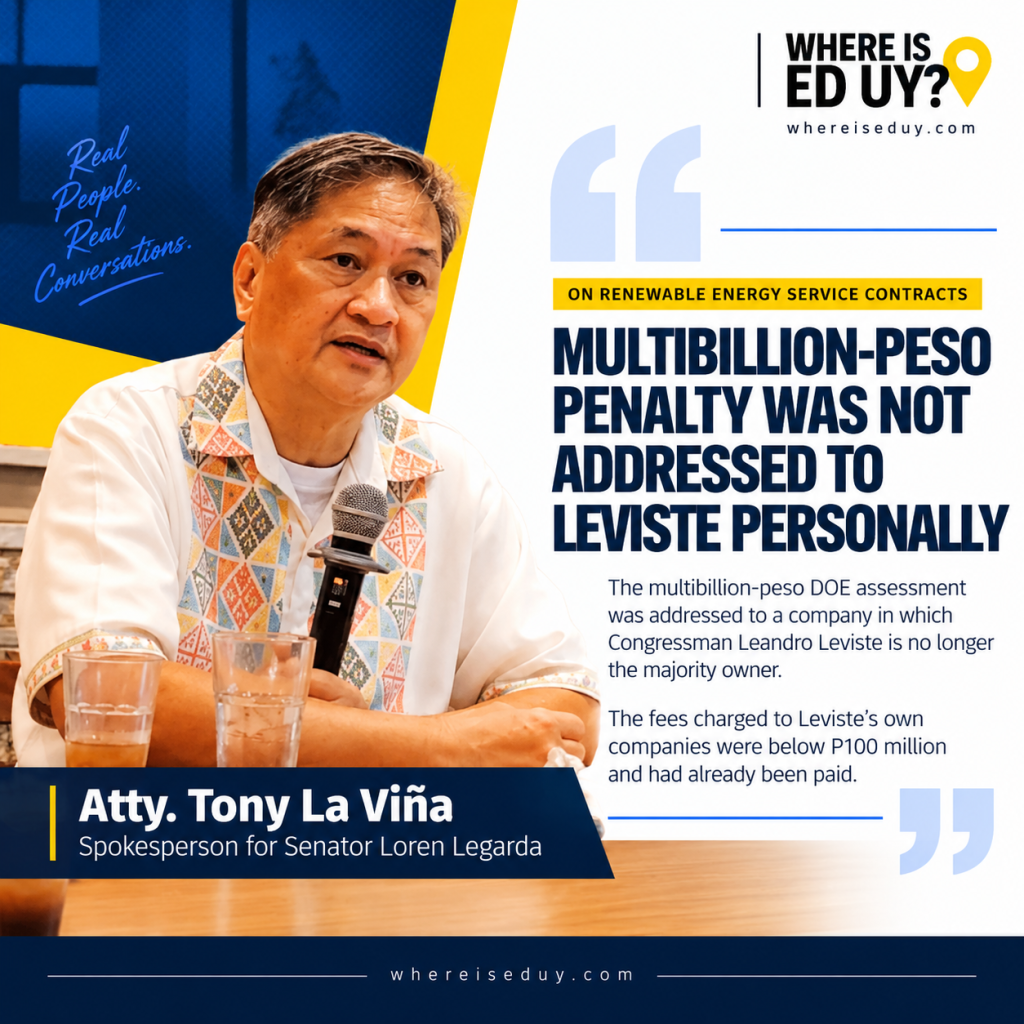
This matters because references to multibillion-peso amounts can easily leave the impression that billions in public funds were given to Leviste for projects that were subsequently not completed.
La Viña disputes that characterization.
He also challenged claims involving alleged P10-billion and P24-billion obligations.
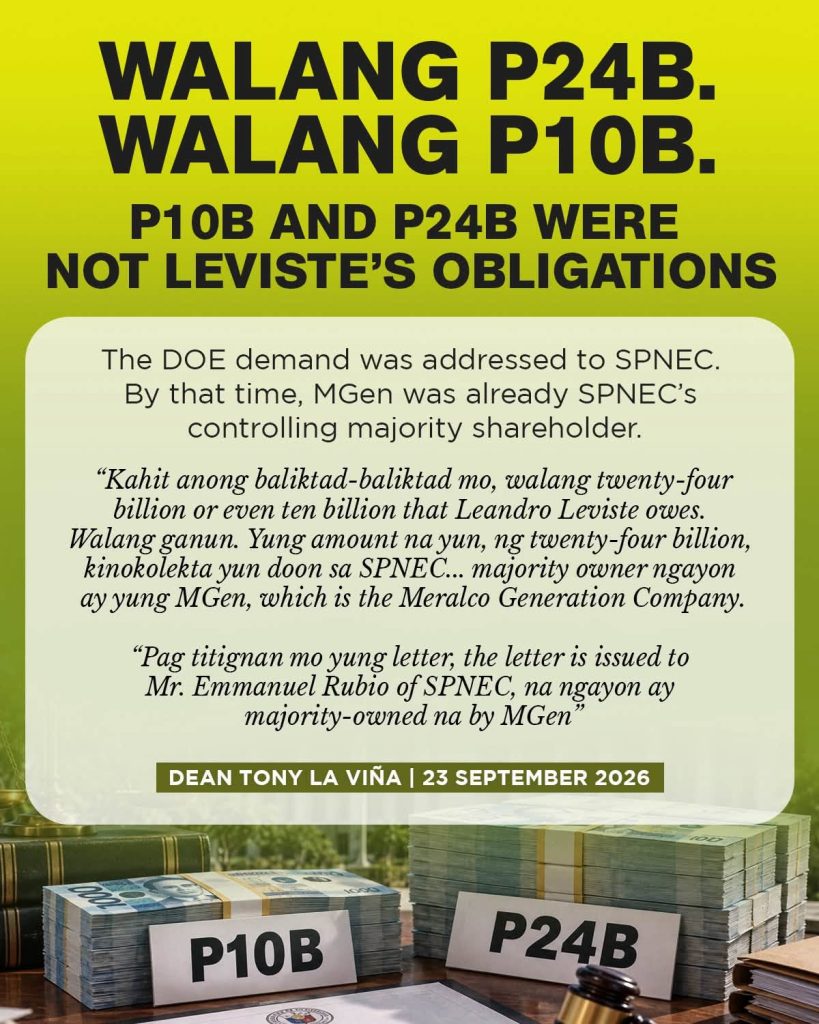
“Kahit anong baliktad-baliktad mo, walang twenty-four billion or even ten billion that Leandro Leviste owes. Walang ganun.”
La Viña said the P24-billion amount being cited was directed at SPNEC and that, by the time of the letter he was referring to, MGen—Meralco Generation Company—was already SPNEC’s controlling majority shareholder.
“Pag titignan mo yung letter, the letter is issued to Mr. Emmanuel Rubio of SPNEC, na ngayon ay majority-owned na by MGen.”
This is also why La Viña rejects descriptions of the SPNEC transaction as Leviste simply acquiring projects and “flipping” them for profit.
“Hindi siya flip,” he said, describing the development of SPNEC as a joint venture in which MGen subsequently became the majority owner.
These claims are among the easiest parts of the controversy to verify because, as La Viña himself repeatedly pointed out, there should be documents.
“For those na hindi naniniwala o skeptical, I ask lang for an open mind. Humingi naman kayo ng resibo. Kami, may resibo kami.”

The Solar Para sa Bayan franchise
La Viña also stressed that the Solar Para sa Bayan franchise and renewable-energy service contracts should not be treated as interchangeable.
He said the congressional franchise granted to Solar Para sa Bayan was non-exclusive.
“Merong franchise, yung Solar ng Bayan na franchise, na binigay ng Kongreso. [It is] non-exclusive.”
According to La Viña, implementation also required the Department of Energy to issue rules and regulations and identify the areas where the franchise could operate.
He maintains that this did not happen.
“Hindi naglabas ‘yung Department of Energy ng rules and regulations to implement the solar franchise. Hindi rin naglabas ang gobyerno, ang DOE, ng mga lugar kung saan siya pwedeng i-implement.”
La Viña further said the franchise was never sold.
According to him, because it was not implemented, it was automatically revoked two years after its approval.
“May resibo ako na hindi ‘yun nabenta ever to anyone,” he said. “Revoked na kasi yung franchise.”
What about Loren Legarda?
Then there is perhaps the most politically sensitive question: where does Senator Loren Legarda fit into her son’s business?
La Viña’s answer is unequivocal.
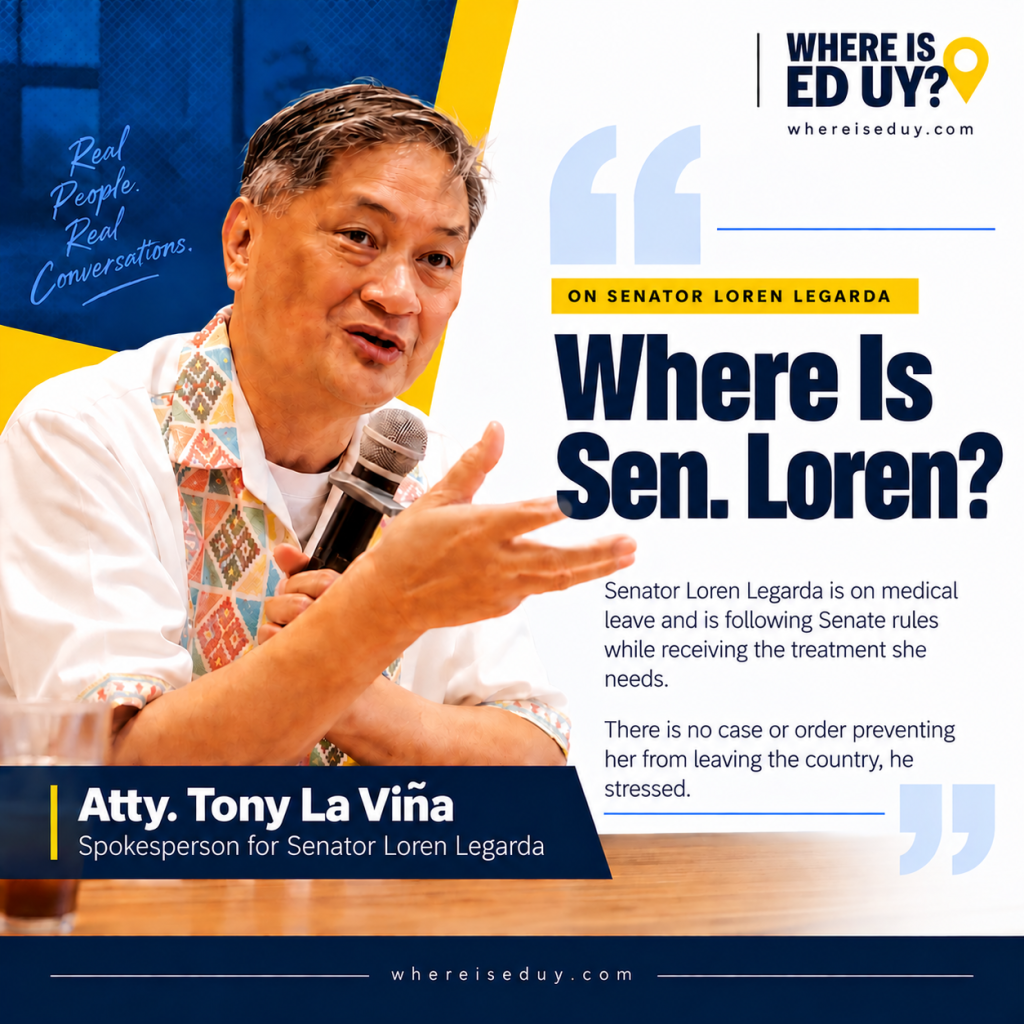
“Yung nanay niya has nothing to do with the business except that she’s a mother.”
His position is that Legarda was not part of Leviste’s renewable-energy business and that allegations concerning the performance of her son’s companies should not automatically establish wrongdoing on her part.
That does not answer every allegation being investigated. But it explains the distinction La Viña wants the public to make: questions surrounding Leviste’s companies and questions concerning Legarda’s personal conduct require separate evidence.
La Viña has also questioned the timing of the investigations, saying the problems intensified after Leviste began raising allegations concerning corruption in Congress and flood-control projects.
“If hindi nila gagawin yun, na i-review nila yung kanilang facts and keep on doing that, I have to suspect na this is about politics,” he said.
That is La Viña’s interpretation of the timing, rather than an independently established motive behind the investigations.
Go back to the documents
Perhaps the most useful point from our conversation had nothing to do with deciding who was right.
It was La Viña’s challenge to examine the records.
“We’re urging her and her staff to review their facts. Review nila yung mga letters nila. Review nila yung kanilang mga sinasabi,” he said, referring to the DOE. “But we’ll give them a chance to correct themselves.”
That same standard should apply to everyone following the controversy.
A service contract is not automatically a completed power plant. An unfinished project is not automatically proof of plunder. A multibillion-peso assessment is not automatically the same thing as billions of pesos of government money disappearing.
But neither should any assertion from the defense automatically be accepted simply because it sounds plausible.
There are contracts. There are letters. There are corporate records. And, according to La Viña, there are receipts.
Those documents ultimately matter more than another viral quote card.
Because when politics produces more noise than clarity, the most useful question isn’t which side do you believe?
It’s much simpler:
What do the records actually show?