

Prologue:
Spending my elementary and high school days at a catholic school (Lourdes School of Quezon City), studying the lives of saints has been an integral part of our Christian Living subject. I even recall one assignment where we were asked to name all the patrons of each day of the year.
Unfortunately, much like the periodic table, I could barely remember the names of these saints, except for the more famous ones.
But one name that I’d never forget is St. Benedict– not because of his life story or the miracles he performed, but because he’s become a part of our home—the foundations of our house to be exact.
It was one of my classmate’s mom who told my mother to place a “St. Benedict” medallion at each pillar/foundation of our home (in addition to offering the blood of native chickens, I think). It was supposed to make the house sturdy, and ward off evil spirits.
It was only recently that I checked out if that was the real purpose of the medallion and here was what I found on the internet.
From source
The Saint Benedict Medal in the middle of a Celtic Cross is believed to be a powerful tool against evil influences and this medal is used in numerous ways: on a chain around the neck; attached to one’s rosary; kept in one’s pocket or purse; placed in one’s car or home; PLACED IN THE FOUNDATION OF A BUILDING; placed in the center of a cross.
The use of any religious article is intended as a means of reminding one of God and of inspiring a willingness and desire to serve God and neighbor.
It is supposed to be effective in many ways: to destroy witchcraft and all other diabolical and haunting influences; to impart protection to persons tempted, deluded, or tormented by evil spirits;
to obtain the conversion of sinners into the Catholic Church, especially when they are in danger of death; to serve as an armor against temptation; to destroy the effects of poison; to secure a timely and healthy birth for children; to afford protection against storms and lightning; to serve as an efficacious remedy for bodily afflictions and a means of protection against contagious diseases.
I guess it’s really effective as we’ve never been tempted, deluded, or tormented by evil spirits (only evil people sometimes) and our house has always felt safe even for our guests.
———————————————————————————————————————–
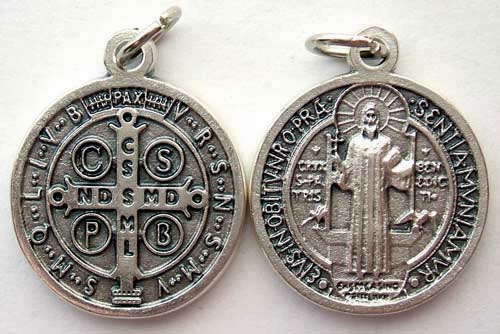
The Front Side – St. Benedict is shown at the center of the medal. In his right hand he holds a cross. The cross represents the saving power of Christ and the work of evangelization by the Benedictines over the centuries. In his left hand is a book containing the Holy Rule of his order. To his right is a broken cup. This cup was said to be poisoned by monks who did not like it when he became Abbot of their monastery. The cup was shattered when St. Benedict made a sign of the cross over it, and his life was saved. To his left is a raven. The raven carried away a poisoned loaf of bread the monks tried to give St. Benedict.
Above his head are the words: Crux Sancti Patris Benedicti (Cross of the Holy Father Benedict). Around the edge are the words: Ejus in obitu nostro praesentia muniamus. (May we at our death be fortified by his presence).
———————————————————————————————————————–
So I kinda felt guilty that I haven’t actually said a prayer of thanks to St. Benedict or visited the San Beda church to thank him for keeping our house strong, sturdy and my family safe.
I finally got the chance to return to the San Beda Chapel or the Abbey of Our Lady of Montserrat (as I would later learn), when Alwyn Ignacio invited me and several other writers to meet a visiting Italian Master Painter Francesco Giannini.
I simply “googled” Francisco Giannini but the initial results that came up was about a namesake filmmaker and his short video “Stand” which is basically about, yep a One Night Stand, so I knew I had to add “painter” to his name to get better results.
AN ITALIAN MASTER IN MANILA
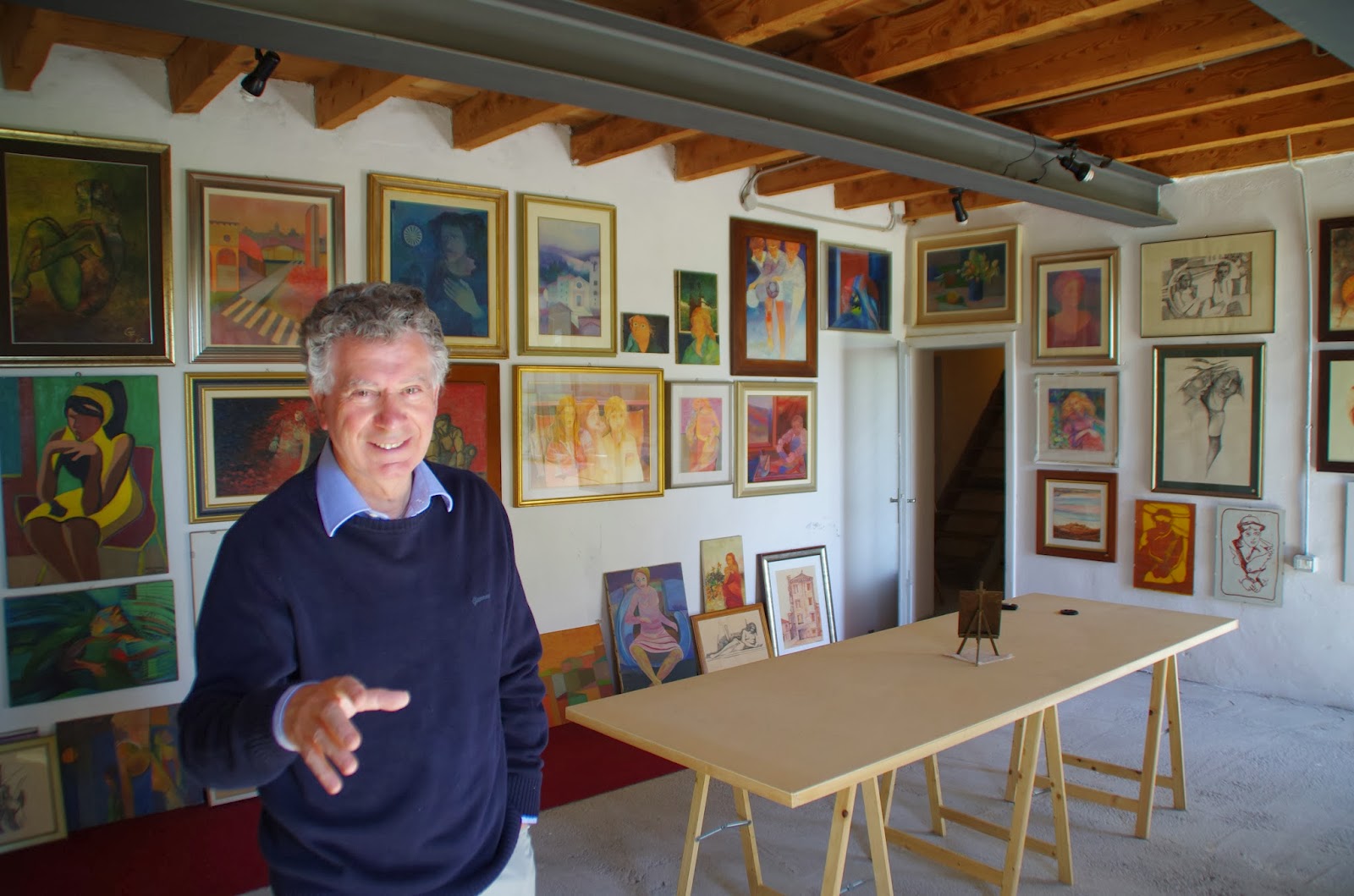
I was expecting to see an eccentric looking man like most “artists,” instead Signore Francesco looked more like a priest—with his calm, and very soft spoken demeanor—except when he was talking about his work.
Born in Barletta, Italy, on February 4, 1942, Francesco Giannini is one of those artists who did not venture into the vocation unarmed. He studied art at the Higher School of Art in the Sforzesco Castle in Milan under the tutelage of Professors Beltrame, Alfredo Mantica, and Gino Moro completing his artistic formation at the Art Academy of Brera, Milan. Milan was incidentally where Giannini’s family moved to when he was a child. He has since made Peschiera del Garda, Verona, Italy his home base.
 |
| Francesco Giannini at work in his small studio here in Manila |
Married to a fellow painter, Anita Gatti, Giannini’s career as a painter has been both storied and celebrated. In 1980, he was elected member of the Academy of Fine Arts and Graphic Art in Pisa, aside from also being part of the permanent Society of Fine Arts in both Milan and Verona. He credits his continuous formation and techniques in frescoes under Professor Bellomi in Verona. His son Tiziano, who previously worked for Ferrari, is also a painter.
His carefully crafted masterpieces depict scenery as drawn art and not like some modern pieces that look more photographic. In a sense, it takes you back to a time when Art was solely drawn and made by hand without any digital manipulations. Classic, classy, and very emotionally made.
His style veers towards the vibrant and explosive, with his use of various shades of orange and winey tones of deep indigo, all dissolved in a light which seems to break away, Giannini’s works create an impression of mystery, of breathtaking riddles that draw the curious and the art obsessed.
It is no surprise, that Signore Francesco Giannini’s works are coveted by art collectors in Italy and other parts of the world.
MASTERPIECE AT THE ABBEY OF OUR LADY OF MONTSERRAT

Master Francesco was commissioned to do the Benedictine Story in the Philippine Islands, a grand mural which now adorns the Abbey of Our Lady of Montserrat.

It may be that Giannini only became a Secular Franciscan, or a member of the Secular Franciscan Order – a community of Catholic men and women who seek to pattern their lives after Christ in the Spirit of St. Francis of Assisi – in March 2013, but way earlier than that, Giannini seems to have already begun a spiritual journey through his art.
According to Fr. Aelred Nilo, OSB, who served as Signore Francesco’s interpreter, Giannini’s transition to creating religious art began while he was on a retreat at the Basilica of Saint Francis in Assisi. He worked and restored murals in the monastery of the Benedictine nuns of San Guisseppe, Assisi, in exchange for his stay there.
It was also during this time, in 2006, when Fr. Aelred Nilo met Francesco. Fr. Nilo, was then serving as Chaplain of the nuns while taking his summer break from his Monastic Studies at the Ateneo Sant’Anselmo in Rome. When Francesco visited Manila in 2009, he persuaded him to do the Benedictine Story in the Philippine Islands.
The grand mural is composed of seven panels of jute canvas measuring 126 sq m, the massive painting is a fusion of spirituality, artistry and history to which Giannini employed his trademark palette of earthy oranges and celestial blues and neo-Impressionist style.
VISUAL STORY TELLING
The narrative painting visually portrayed the Benedictine story in the Philippines their mission, evangelization and heritage for the past 100 years.
“Maestro Giannini stunningly captured in paintings the Benedictine response to the Gospel — our monastic life and educational apostolate. He colorfully recounted the Benedictine origin of the Subiaco Congregation, their mission in Asia and their contribution to the Philippine society in particular,” stated Fr. Nilo in one of his writings.

Fr. Nilo continues, “At the uppermost center of the mural, the resurrected Christ is depicted with the two angels; one contemplates the Lord’s face, while the other with Asian features reverently gazes the pierced side of Jesus. Christ is actually embracing the globe in the form of a Saint Benedict medal to signify the presence of the Benedictines all over the world. The resurrection event reminds us of the beginning of the church. By the turn of 4th century, monastic life became the radical way to follow and live the gospel. In the west, Saint Benedict of Nursia became known as the father of Western Monasticism. Saint Benedict first lived as a hermit in Subiaco (SacroSpeco) at the end of the 5th century. Because of his holiness, he gained disciples and became the Abbot of a group of monks. To guide his monks he wrote a rule and became the standard rule of life by the monks until the middle ages. His rule spread all over Europe and the Spanish monastic community sprang up in Montserrat, Barcelona, Spain – the Abbey of Our Montserrat Barcelona.
In 1895, fourteen Benedictine monks from Montserrat, Barcelona boarded a boat for an expedition to the Philippines and they ended up in Siargao Island. To commemorate the monks’ arrival in the country Siargao Island and the church where they used to work is represented in the mural. Since they arrived in the country at the height of Filipino uprising against Spanish government, they ended up in Manila and founded Colegio di San Beda in 1901 to counteract Protestantism. Thus we depicted the church of the Abbey of Our Lady of Montserrat Manila whose monks runs San Beda College.
“On the lower left panel of the mural facing back the altar, 18 Benedictine monks were martyred between 1936-1939 during Spanish Civil War in Spain. The Civil War became notable for the passion and political division it inspired. Tens of thousands of civilians on both sides were killed for their political or religious views. Three of those martyred monks were monks of Montserrat, Manila – Santiago Pardo Lopez (1905-1925), Domingo CaballeBru (1921-1926) and Bro Eugenio Erasquin (1920-1922). The three bamboo crosses with the sun in the background suggest the Asian ties of the three martyrs depicted at the center of the panel. Indeed, they have shed their blood in faith and become salt of the earth.”
“…And so we find at the lower center panel the 14 pioneer monks who brought with them the image of the Madonna of Montserrat. Together in the panel are the Abbots of the Abbey for the past one hundred years. Together, the pioneers and the Abbots, they pass on the cultural values and moral principles that continue to guide our social life and religious upbringing. For more than one hundred years in the Philippines, the Benedictine monastic’s and school administrators continue to give witness to the Benedictine values they apply in the community and in their apostolate.
“We are also called to be the light of the world. It means we are to be light in all aspects of the world’s life. The martyrdom of Saint Maximilian Kolbe is itself a light to the world. His selfless sacrifice is thus commemorated in the mural via the Mass he celebrated in our Abbey church in 1936. With him celebrating the mass are the Filipino martyrs (San Lorenzo Ruiz and Pedro Calungsod), religious founders in the Philippines, common Filipino people, our alumnus Ninoy Aquino and his wife Corazon.” Source
Francesco joked that the doing the painting was “not difficult—but almost impossible.”
As an artist is also not one to walk away from challenges. He faces it head-on, such as the task of working on vast surfaces, resulting in extraordinary works like the murals in Monza near Milan, and the baptismal font in the parish church of Oliosi near Verona, and the works he has carried out. The project took him almost three years working very long hours at his studio starting at 8am and coming home at 9pm. “My wife was worried, she thought I was already going MAD!,” he shared.
 |
| Fr. Nilo and Francesco Giannini |
“Painting for me is not entertainment, it’s work that opens the door of my faith. It’s a challenge for me and I didn’t know if I could do it at first but I accepted it with faith,” Giannini admitted.
Fr. Nilo adds that all the persons included in the mural are real people who lived and contributed to the mission of the St. Benedict and the faces were based on the photos of the real persons.
The most difficult part for Giannini was painting the image of Saint Maximilian Kolbe as there was no photo of him to base it on. The master painter also had to visit several old churches to get the altar table, the chalice etc… depicted correctly.

But the most impressive part of the mural isn’t the painting itself—but the tremendous effort and dedication of Francesco who did this giant masterpiece for FREE.
“All he asked in return was that we accommodate him when he visits the Philippines,” Fr. Nilo said.

Signore Francesco has visited the country numerous times, and has been here since September meeting several local artists such as Ben Hur Villanueva and Ben Cab and says he is open to working with them in the future.
Rosemary Clay wrote, “In the production of this magnificent work (dare we call it a modern masterpiece) Francesco has perhaps fulfilled all he has ever attempted to achieve in the course of an artistic life covering more than 50 years, availing himself of all his past experience, his creativity, and his God-given artistic fervour and passion.”

From January 13-19, 2014, a week long exhibit featuring the distinguished works of Francesso Giannini will be on display and for sale at the Showcase Area, Bldg. A of SM Megamall in Ortigas. The exhibit opens on January 13 at 10:30 AM and will be graced by the Italian painter himself.
Gazing at and owning a piece of Giannini’s inspired artistry is like being part of the whole rigorous process of creating art itself. As Francesco Giannini himself puts it: “If others look at my work and are also touched by it, then it would be a great satisfaction to me.”
For more information about Francesco Giannini, visit http://www.artediarte-fgiannini.com
 |
| from left Jocelyn Dimaculangan, Arnel Ramos, Alwyn Ignacio, Rachelle Santos Francesco Giannini, Jude Cartalaba, Neil Ramos and Ed Uy (author) |
Epilogue:
As I kept clicking away (with my Samsung Galaxy S4 Zoom more photos here) to take a lot of pictures which I could post and share, I realized that no photo could actually do justice to the magnificent work of Signore Francesco and you definitely have to see it for yourself… so, I just stared in awe as Fr. Nilo told the story of each panel.
It was then that I understood why people probably placed the St. Benedict medallion on the foundation of their houses, because like the Benedictine monks and priests, it was their faith in God and St. Benedict that kept them going throughout their mission, and sometimes prosecution, and made their church solid and strong as ever.
“Christians are called to be the salt of the earth. When we wish to highlight a person’s worth we often say that he or she is the salt of the earth. In the ancient world, salt was highly valued. Salt performs two important functions. It is the commonest of all preservatives and it keeps things from going bad. Secondly, salt gives taste and flavor to food. Food without salt is insipid.
The Christian’s mission is to be the salt of society, preserving, reconciling, adding taste, giving meaning where there is no meaning, and giving hope where there is no hope. It is about the quality of life.
Now that we have told our story, may these mural paintings done by Maestro Francesco Giannini inspire each one of you to become truly salt and light of the world. As Christians, as followers of Christ, may we be an active agent of change, an ambassador of goodwill, giving witness to our Christian faith in order to bring life, love and joy to our fellow men and women. That in all things God may be Glorified.”
(Fr. Aelred Nilo, OSB)