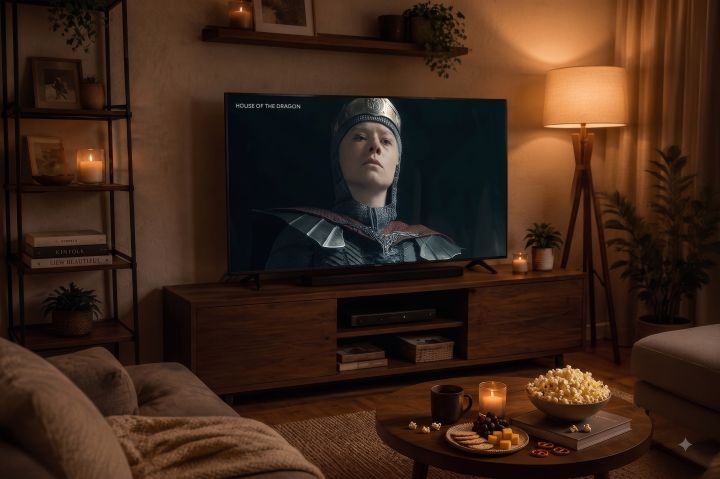


A few weeks back, I wrote a column about the best and worst parts of living alone—including the undeniable pleasure of having complete control over the TV, my viewing schedule, and, perhaps most importantly, the remote.
But there is one downside I forgot to mention.
When you live alone, every bill has your name on it.
There’s nobody to split the internet bill with. Nobody else is paying for the streaming services. Your mobile plan, cloud storage, apps, and all those little monthly subscriptions that seemed cheap when you signed up? They are yours, yours, yours and yours.
And apparently, I’ve collected quite a few.
I realized this recently while going through my monthly expenses and seeing just how many separate services have become part of my normal life. There are my internet connection, mobile plan, streaming subscriptions, cloud storage and apps I actually use—plus probably a few recurring charges I signed up for months ago and have completely forgotten about.
You know the ones. A charge appears on your statement and you stare at it for a few seconds thinking, Ano nga ulit ito?
Then there’s the other kind of digital clutter: passwords, accounts, renewals, and verification codes.
And now that I’ve officially entered what people politely call their “golden era,” I’ve developed a much greater appreciation for simplicity.

Multitasking doesn’t quite feel like the superpower it once did. My memory has become increasingly selective. I can remember the lyrics to a song I haven’t heard since the ’80s, but ask me which variation of my password I used for a streaming service three months ago, and suddenly, we’re in trouble.
Was it the one with the capital letter? The exclamation point? Did I use my old password and add a number because the app insisted I create a “new” one?
And don’t get me started on verification codes. By the time I switch from one app to another to retrieve that six-digit code, there’s a very real chance I’ve forgotten what I was trying to log into in the first place.
That’s why “Sign in with Google” has been a reliable friend.
Okay, maybe I’m exaggerating.
A little.
But that’s also why I’ve become less impressed by technology that gives me another thing to manage. These days, I appreciate services that take something off my plate.
We keep adding digital services because they’re supposed to make life more convenient. But at some point, managing all that convenience becomes a chore in itself – another thing to remember, maintain, and update.
And here’s what really got me thinking: I have to manage all these for one person.
Imagine doing it for an entire family.
Chaos.
ONE HOME, MANY DIGITAL LIVES
Think about what happens inside a Filipino home on an ordinary evening.
Someone could be watching TV in the living room while another family member catches up on a series on a tablet. One child is gaming with friends, another is scrolling through videos on a phone, while someone else has a laptop open for work or school.
At any given moment, the whole family can have multiple screens and devices running simultaneously, all competing for the bandwidth to stay connected.
Meanwhile, other devices remain connected in the background, barely noticed until the Internet stops working.
Then everyone walks out the front door, and another set of digital needs kicks in. Mobile data takes over for messaging, maps, social media, video calls, music, and all the other things we’ve become accustomed to having wherever we go.
That’s how dramatically our digital lives have changed.
I remember when having internet at home meant having one computer connected to it. You went online, did whatever you needed to do, and logged off.
Everyone had a schedule. Everyone had to share on a limited bandwidth.
Today, I couldn’t even tell you how many things in my home are connected without walking around and counting them.
The internet isn’t something we occasionally use anymore. It’s simply there, running through practically everything we do.
THE LITTLE BILLS THAT ADD UP
There’s another reason our digital lives can become deceptively expensive: most subscriptions don’t look particularly expensive on their own.
That’s how they get you.
A couple hundred pesos here. Another subscription there. You subscribe because there’s one series you really want to watch. You keep another because you use it occasionally. Add home internet, mobile data, and entertainment to the equation, and suddenly quite a few monthly charges are competing for a piece of your budget.
Each expense can seem perfectly reasonable on its own.
It’s only when you see them together that you realize how many separate things you’re actually paying for.
And that’s made me rethink what “value for money” means when it comes to connectivity.
For years, choosing a home internet plan largely came down to two questions: How fast is it, and how much does it cost?
Those questions still matter. But I’d add a third one now:
What else am I getting for my money?
Because if I’m already paying separately for home internet, entertainment, and mobile connectivity, perhaps the smarter choice isn’t finding a slightly cheaper version of each.
Maybe it’s asking why I’m paying for everything separately in the first place.

SO WHAT EXACTLY IS FIBER UNLI ALL?
That’s what caught my attention about the new PLDT Home Fiber Unli All plans.
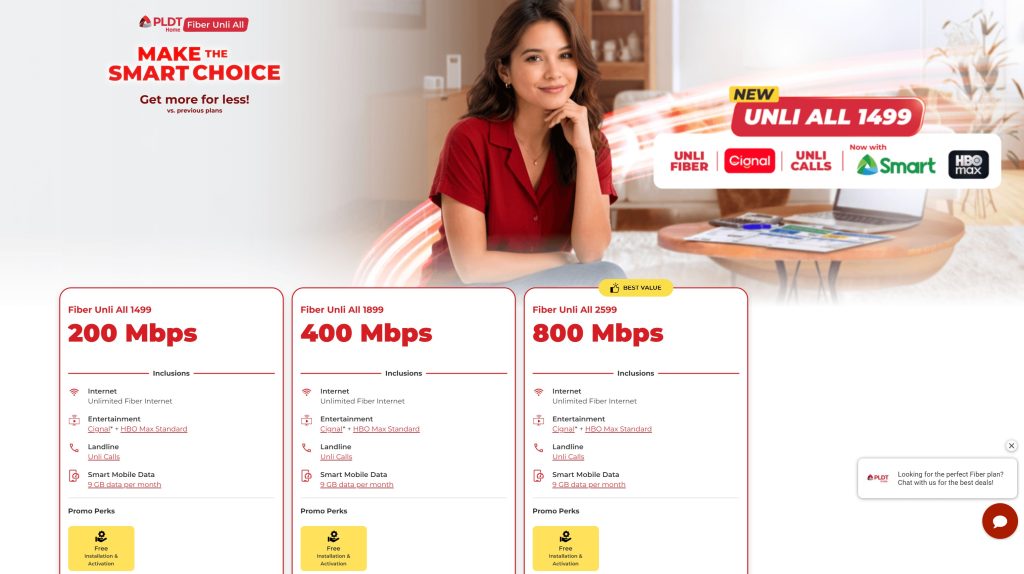
Take Fiber Unli All 1499. For ₱1,499 a month, you get 200 Mbps unlimited fiber internet, 63 live Cignal channels, HBO Max Standard, Unli Calls and a total of 9GB of Smart mobile data every month.
That’s a pretty long list for something we traditionally think of as an internet plan.
And that’s precisely the point.
Instead of treating broadband, entertainment, calls, and mobile data as separate needs, PLDT Home Fiber Unli All plan puts them together.
The Cignal inclusion gives households 63 live channels, while HBO Max Standard allows two people to stream simultaneously in Full HD. The included landline also comes with unlimited landline calls to five nominated Smart, Sun, or TNT numbers.
The Smart mobile data inclusion is particularly useful for families. The 9GB allocation is shared among up to three registered Smart or TNT numbers and valid for 30 days.
In other words, the benefits aren’t necessarily meant for one person to hoard. They’re designed to be shared around the household.
There is a Fiber Unli All plan for every budget and bandwidth requirement. Fiber Unli All 1899 offers speeds of up to 400 Mbps, while Fiber Unli All 2599 goes up to 800 Mbps. For me, the sweet spot is Fiber Unli All 1499 with speeds of up to 200 Mbps. All these Fiber Unli All plans come with the same core combination of unlimited internet, entertainment, calls and mobile data.
Now the “All” in Fiber Unli All makes a lot more sense.
ONE DIGITAL LIFE, DIFFERENT SCREENS
What I like about bundled services such as Fiber Unli All is that it reflects how we really use technology.
I could start the morning working at home, stream something during lunch, head out to cover an event and rely on mobile data for messages, navigation and social media, then return home and end the day watching something on HBO Max.
I haven’t suddenly developed three different digital lives.
It’s still me. I’ve simply moved from my laptop to my phone to my television, and from home to somewhere else and back again.
Multiply that behavior by three, four, or five people in the same household, and you begin to understand why looking at connectivity as nothing more than “home internet” feels increasingly outdated.
The smarter approach isn’t adding another service every time we want something new; it’s finding a way to make the services we already use work better together.
Besides, at this stage of my life, anything that means one less bill to remember and one smart way to manage my subscriptions already sounds like an upgrade.
THE BEST THINGS IN LIFE ARE…
People always say the best things in life are free.
Love. Friendship. Family. A beautiful sunset.
That’s true enough. But these days, some things that enable us to enjoy, relax, and be worry-free require a monthly subscription.
And whoever came up with that saying clearly wasn’t paying the bills for fiber internet, streaming services, mobile data, and all the other digital essentials that our families need.
And I’m perfectly fine to pay for the things that make my life easier, keep me connected, help me stay productive, and give me something good to watch at the end of a long day. What I’m less happy about is the growing administrative burden that comes with them: different bills, separate subscriptions, and services that make it more complicated. If there’s a simpler way to get the same essentials in one place, that sounds like a smart trade-off to me.
Maybe that’s what making the smart choice looks like now.
It isn’t necessarily about getting another app, another subscription or another digital service. Sometimes it’s getting more out of the things you’re already paying for—and having fewer things to worry about along the way.
So perhaps the old saying just needs a little update.
The best things in life may be free.
But when it comes to my digital life? I’ll happily take them UNLI.
So make the smart choice with PLDT Home Fiber Unli All.
Explore PLDT Home Fiber Unli All
Fiber Unli All plans have a 36-month contract period. A ₱100 monthly Internet installation fee applies for 36 months, although the Internet installation fee may be waived for applications eligible for the Fiber Sale Promo. A separate ₱300 Cignal installation and activation fee applies, payable as a one-time charge or ₱50 per month for six months. Terms and eligibility requirements apply. Get your PLDT HOME Fiber Unli All by clicking on this LINK